

Multi-track video editor
Arrange generated or local clips on a timeline, add images and overlays, and lay in music or voice.
Generate and edit images, video, music, speech and text with the newest open models — all running locally on your own GPU. Free, open source and private by design.


Runs the newest open models
Four studios, one app
Image, video, audio and text generation live side by side, with the editing tools to finish the job. Pick a workflow, choose a model and start creating.
Generate from text, transform existing images, edit with plain-language instructions, inpaint, or sketch a rough idea and watch it become a finished piece.
72 image models · 35 LoRAs · 9 ControlNets

 Original
Edited


 Sketch
Result


Turn prompts or stills into motion, restyle existing footage, then upscale, interpolate and cut it all together in the built-in editor.
24 video models. Every clip here was made in Amuse.
Compose full songs from a style prompt and lyrics, generate natural voices in 31 languages, and transcribe or translate speech.
11 audio models. Every track here was made in Amuse.
Chat with local language models that can see images, read documents and call tools like web search, a calculator or file search — all running on your own hardware.
15 language models. These are real chats with Qwen 3.8 27B, thinking included.
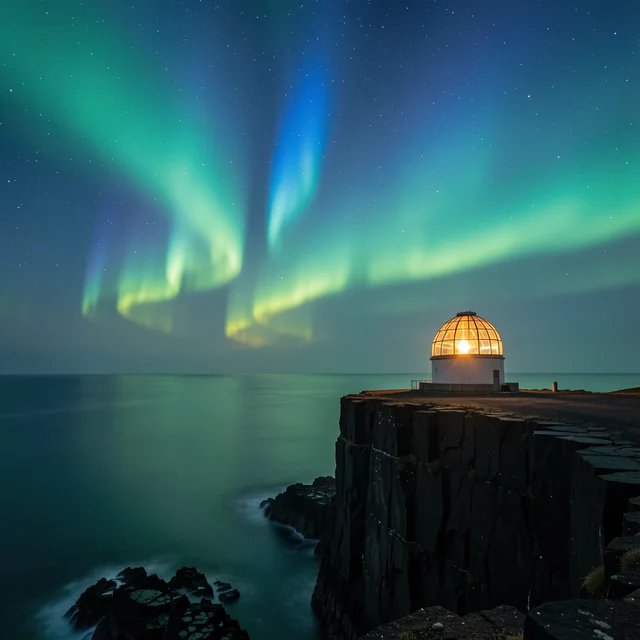
Describe what's happening in this picture in two sentences. Then write a three-line poem that could hang beside it in a gallery.
The user wants two things: a two-sentence description of the image, then a three-line poem suitable for a gallery. Let me look carefully at the image first.
What I see: A night scene. The sky is filled with the aurora borealis—green and blue ribbons of light arcing across a starry sky. Below, a calm sea, long-exposure smooth water, with some rocks in the lower left where waves foam. On the right, a cliff edge (dark, columnar basalt-like rock) with a small lighthouse structure on top. The lighthouse has a glowing dome/cupola, warm yellow light, lit from within. The composition is balanced: aurora on left/center, lighthouse on right.
So the description: two sentences. I should capture the aurora dancing over the sea and the lone lit lighthouse on the cliff.
Now the poem: three lines, gallery-worthy. Should be evocative, not cliché. Tie together the light of the aurora (sky) and the light of the lighthouse (earth), the sea, the night. Maybe a theme of two lights, or guidance, or the sky answering the lamp. Let me draft.
Draft 1:
The sky sets its own lanterns alight,
and the small keeper answers from the stone—
two fires keeping the dark company.
That's three lines, decent. "keeping the dark company" is nice. Let me refine. Maybe:
Green fire unspools across the black,
the lone lamp hums its amber vow—
the sea holds both, and gives them back.
Hmm "gives them back" is a bit odd. Let me think about rhythm and imagery. The aurora is green/blue, the lighthouse amber. The sea reflects.
Draft 2:
The heavens burn their cold green flame,
the cliff returns a single gold—
and the sea, patient, keeps the name
of neither, only the dark.
That's four lines. Need three.
Let me settle on three lines that feel complete and gallery-appropriate. I want a quiet, resonant close.
Final attempt:
The sky ignites in ribbons of green,
the lone lamp answers, small and sure—
two lights, and the sea that holds them both.
That's clean, three lines, evocative, ties the elements. "small and sure" gives the lighthouse character. Good.
Maybe make it a touch more poetic/less prosaic. "ribbons of green" is fine. Could say "the sky sets green fire adrift." Let me polish:
The sky sets green fire adrift,
the cliff answers with one warm lamp—
and the sea keeps the dark company of both.
I like "keeps the dark company of both" — it personifies the sea and ties the two lights together, and "dark company" is a lovely double meaning (company in darkness / companionship). Three lines. Good.
Let me check line lengths for visual balance:
Line 1: "The sky sets green fire adrift," (10 syllables-ish)
Line 2: "the cliff answers with one warm lamp—"
Line 3: "and the sea keeps the dark company of both."
Reasonable. I'll go with this.
Now the two-sentence description. Keep it accurate and vivid.
Sentence 1: The aurora borealis arcs across a star-filled night sky in ribbons of green and blue above a calm, long-exposure sea.
Sentence 2: On a dark basalt cliff to the right, a small lighthouse glows with a warm amber light from its domed lantern room, standing as a lone beacon beneath the dancing lights.
Good. Two sentences.
I'll present description first, then the poem, perhaps with a tiny label. The user said "write a three-line poem that could hang beside it in a gallery" — I'll just present it cleanly, maybe italicized or set off. No need for heavy formatting. I'll keep response self-contained.
No tools needed; this is a static image, no date relevance. I won't call datetime.
Final response structure: two sentences, then a line break, then the three-line poem.
Under a star-scattered night sky, the aurora borealis unfurls in sweeping ribbons of green and blue above a glassy, long-exposure sea. Perched on the edge of a dark, columnar cliff to the right, a small lighthouse burns with a warm amber glow from its domed lantern room, standing as a single steady beacon beneath the dancing lights.
The sky sets green fire adrift,
the cliff answers with one warm lamp—
and the sea keeps the dark company of both.
I'm cooking a three-course dinner for six on Saturday. I have one oven, two hours of prep time, and guests arrive at 7pm. Suggest a simple menu and a timeline that never needs the oven for two things at the same time.
The user is asking for a 3-course dinner for 6 people, with 1 oven, 2 hours of prep time, and guests arriving at 7pm. They want a simple menu and a timeline where the oven is never used for two things simultaneously.
First, let me get the current date/time to figure out what day "Saturday" is. Actually, the user says "Saturday" — I should check the current date to know which Saturday. Let me use the datetime tool.
Actually, the key constraint is: 2 hours of prep time, guests arrive at 7pm. So prep is 5pm–7pm. The timeline needs to fit within that window, and the oven can only be used for one thing at a time.
Let me think about a good menu:
- Appetizer: something no-oven or quick — e.g., bruschetta, caprese, or a simple soup. Or a baked appetizer like stuffed mushrooms.
- Main: something that bakes in the oven — e.g., sheet pan chicken, or a roast.
- Dessert: something that can be made ahead or needs minimal oven time — e.g., a no-bake dessert, or a simple baked item.
Key constraint: the oven is never used for two things simultaneously. So I need to sequence oven uses.
Let me design:
- Appetizer: no oven (e.g., a fresh salad, bruschetta, or a chilled soup). This frees up the oven.
- Main: oven-baked, e.g., a sheet pan with chicken and vegetables, or a roast.
- Dessert: no-bake (e.g., panna cotta, chocolate mousse, or a no-bake cheesecake) — this avoids oven time.
Actually, to make it interesting and realistic, let me think about oven timing.
Let me plan the timeline. Guests arrive at 7pm. 2 hours of prep = 5pm–7pm.
Let me design a menu where oven use is sequential:
Option:
- Appetizer: no oven — e.g., a simple antipasto / bruschetta / salad. Can be prepped and served at 7pm.
- Main: oven — e.g., a sheet pan dinner (chicken thighs + vegetables) that bakes for about 40–45 minutes.
- Dessert: no-bake — e.g., panna cotta or a no-bake cheesecake that's set in the fridge.
Timeline:
- 5:00pm: Start. Prep the main (season chicken, chop vegetables). Preheat oven.
- 5:10pm: Oven on, preheating.
- 5:30pm: Oven reaches temp. Put main in the oven.
- 5:30–6:15pm: Main bakes (45 min). During this time, prep the appetizer (no oven) and set the table.
- 6:15pm: Main done, remove from oven, rest.
- 6:15–6:45pm: Oven is free. If the dessert needs the oven, do it now. But if the dessert is no-bake, no oven needed.
- 6:45pm: Plate the appetizer, serve at 7pm.
- 7:00pm: Guests arrive, serve appetizer.
- 7:15pm: Serve main (it's been resting, still hot).
- 7:45pm: Serve dessert (no-bake, from fridge).
Wait, but the main needs to be served after the appetizer. If the main bakes from 5:30–6:15 and rests, it can be served at 7:15. That works — it stays warm.
Actually, let me reconsider. The constraint is "the oven is never used for two things simultaneously." So as long as I sequence oven uses, it's fine. Let me make sure the plan is clean.
Let me refine to make it a solid, simple menu. Let me think about what's realistic and simple for 6 people.
Menu:
1. Appetizer: Caprese crostini (no oven) — tomatoes, mozzarella, basil, balsamic, on baguette slices. Quick, no oven.
2. Main: Sheet pan lemon-herb chicken thighs with roasted potatoes and vegetables (oven, one pan, about 45 min).
3. Dessert: No-bake chocolate mousse or panna cotta (no oven, set in fridge).
This is clean: only the main uses the oven, so there's no risk of two things in the oven at once.
But maybe the user wants a bit more. Let me consider whether to include an oven dessert to show the sequencing. Actually, the simplest and safest approach is to have only one oven item (the main) and make the appetizer and dessert no-oven. That guarantees the constraint is met.
But to be more helpful, I could show how to sequence if they want an oven dessert. Let me keep it simple but mention the flexibility.
Actually, let me reconsider the timing. 2 hours of prep (5–7pm). Let me make the timeline detailed and realistic.
Let me also consider: should the main go in the oven earlier so it's ready? If guests arrive at 7 and the appetizer is served first, the main should be ready around 7:15–7:20. So the main should finish baking around 6:30–6:45 and rest until 7:15.
Let me redo:
- 5:00pm: Preheat oven to 425°F (220°C). Prep: chop vegetables, season chicken.
- 5:15pm: Oven preheated. Assemble sheet pan, put in oven.
- 5:15–6:00pm: Main bakes (45 min).
- 5:15–6:00pm (parallel, no oven): Prep the caprese crostini, set the table, chill the dessert.
- 6:00pm: Main done. Remove, tent with foil, rest.
- 6:00–6:45pm: Oven is free. (If you want an oven dessert, do it now — but our dessert is no-bake.) Final prep, plate the appetizer.
- 6:45pm: Bring the main to the table (still hot), or keep it warm.
- 7:00pm: Guests arrive. Serve the caprese crostini.
- 7:20pm: Serve the main.
- 7:50pm: Serve the dessert.
This is clean. The oven is only used for the main, from 5:15–6:00. No overlap.
Hmm, but the user said "2 hours of prep time." So they have 5–7pm. My timeline uses that well.
Let me also think: is it better to have the main finish closer to serving? Chicken thighs at 425°F take about 40–45 min. If I want it served at 7:20, I could bake from 6:00–6:45 and rest until 7:20. That gives a 35-min rest, which is a bit long but fine if tented and the oven stays warm. Actually, a long rest can dry it out. Better to bake earlier and rest, or bake later.
Let me reconsider. To keep the chicken juicy, I want the rest to be about 10–15 min. So if serving at 7:20, bake from 6:00–6:45, rest 6:45–7:00 (15 min), then... but guests arrive at 7:00 and the appetizer is served first. So the main is served at 7:20. If it rests 6:45–7:00 and then sits until 7:20, that's 35 min total. A bit long.
Alternative: serve the main right when guests arrive, and make the appetizer a "while you wait" thing. Or, make the appetizer something that's served as guests arrive, and the main is ready at 7:15.
Actually, a common approach: the main is the centerpiece and is served hot. Let me have the main finish at 6:45, rest until 7:00, and be served at 7:15 (15 min after guests arrive, after the appetizer). That's a 30-min rest total. To keep it warm, I can keep the oven on low (200°F) with the pan inside, or tent it well.
Hmm, let me simplify. I'll present a clean timeline and note that the main rests tented and can be kept warm. Let me not overthink the exact minutes; I'll give a reasonable timeline.
Let me reconsider the whole thing to make it robust and simple. I think the cleanest design is:
- Only one oven item (the main).
- Appetizer and dessert are no-oven.
This guarantees the constraint. Let me write it up.
Actually, I realize I should double check the current date to know which Saturday, but it's not strictly necessary for the timeline since the user gave "guests arrive at 7pm" and "2 hours of prep." The day of the week doesn't change the timeline. But it might be nice to confirm. Actually, the datetime tool gives the current date. Let me get it to be thorough, but it's not essential. The user's constraints are self-contained (7pm arrival, 2 hours prep). I don't think I need the current date. But let me consider — "Saturday" — if today is, say, Wednesday, then Saturday is 3 days away. That doesn't affect the timeline. I'll skip the datetime call since it's not needed for the answer. Actually, it might be a nice touch to confirm, but it's not necessary. Let me not overuse tools.
Hmm, but the instructions say to use tools when I need accurate current date/time. I don't really need it here. The answer is self-contained. I'll provide the menu and timeline directly.
Wait, let me reconsider whether I should verify anything with a web search. The cooking times for chicken thighs and the menu are standard knowledge. I don't think I need a web search. This is a planning/logistics question, not a fact-checking question. I'll answer from knowledge.
Let me write a clear, well-organized response with:
1. The menu (3 courses, simple, only one oven item).
2. The timeline (5pm–7pm prep, then service).
3. A note on how the oven constraint is satisfied.
Let me make it practical and scannable.
Let me finalize the menu:
Appetizer (no oven): Caprese crostini — sliced baguette, fresh mozzarella, cherry tomatoes, basil, olive oil, balsamic, salt/pepper. Serves 6 easily (about 12–15 crostini).
Main (oven, one sheet pan): Lemon-herb chicken thighs with roasted potatoes and vegetables (e.g., zucchini, bell peppers, red onion). One pan, 425°F, about 45 min. Serves 6 (6 thighs, or 8–10 if smaller).
Dessert (no oven): Chocolate mousse cups or panna cotta — set in the fridge, no baking. Or a simple no-bake option.
Actually, for simplicity and to minimize work, let me pick desserts that are truly no-effort. Panna cotta needs gelatin and setting time (a few hours), so it should be made the day before. Chocolate mousse can be made a few hours ahead. Let me suggest panna cotta made the day before (set overnight) — that's the easiest and most elegant. Or a no-bake chocolate mousse.
Let me go with: Dessert = panna cotta (made the day before, set overnight) or a no-bake chocolate mousse. I'll suggest panna cotta as the primary since it's set and ready.
Actually, to keep it "simple," maybe a no-bake chocolate mousse or even a simple fruit-based dessert. Let me offer panna cotta (day-before) as the main suggestion and note a mousse alternative.
Let me also add a "day-before" prep note since panna cotta needs to set.
Let me write the timeline clearly.
Timeline (assuming 5:00–7:00pm prep):
Day before:
- Make the panna cotta, refrigerate to set (4+ hours / overnight).
- Optional: chop some vegetables for the main.
Saturday:
- 5:00pm: Preheat oven to 425°F (220°C).
- 5:00–5:20pm: Prep the main — season chicken thighs, chop potatoes and vegetables, toss with oil, lemon, herbs.
- 5:20pm: Oven is hot. Spread everything on one sheet pan, put in the oven.
- 5:20–6:05pm: Main bakes (about 45 min).
- While it bakes (no oven needed): assemble the caprese crostini, set the table, get the panna cotta from the fridge.
- 6:05pm: Main done. Remove from the oven, tent loosely with foil, and let it rest.
- 6:05–6:45pm: Oven is free (nothing else needs it). Final touches — plate the crostini, bring out bread/wine, set the table.
- 6:45pm: Bring the main to the table (still hot) or keep it tented.
- 7:00pm: Guests arrive. Serve the caprese crostini.
- 7:20pm: Serve the main (chicken + roasted vegetables).
- 7:50pm: Serve the panna cotta.
Oven usage: only the main, 5:20–6:05pm. Never two things at once. ✓
This is clean and satisfies all constraints. Let me present it.
Let me make sure the chicken timing is right. Bone-in skin-on chicken thighs at 425°F: about 40–50 min until cooked through (internal 165°F). Potatoes (cut into 1-inch pieces) roast in about 40–45 min. So 45 min is reasonable. Good.
Let me also note that if they want the main to be perfectly timed, they can start it a bit later. But the plan works.
One more consideration: the user said "2 hours of prep time." My timeline uses 5:00–7:00 as prep, which is exactly 2 hours. Good. And the oven is only used during that window for the main.
Let me also add a small note: if they'd prefer an oven dessert, they could use the free oven time (6:05–6:45pm) for a quick bake, but the no-bake dessert keeps it simplest and guarantees no overlap.
I think this is a solid, complete answer. Let me write it up in a clear, friendly, scannable way. I'll use headers and a timeline. I won't use tools since this is a planning question answerable from knowledge.
Let me reconsider: should I confirm the date? The user said "Saturday." If I want to be thorough, I could note "assuming you start prep at 5pm." I'll frame the timeline around the 7pm arrival and 2-hour prep, which is what they gave. I don't need the actual calendar date. I'll skip the tool.
Let me write the final answer.
Here's a menu built so the oven is only ever used for one thing (the main), which makes the "never two at once" rule easy to guarantee.
| Course | Dish | Oven? |
|---|---|---|
| Appetizer | Caprese crostini — baguette slices, fresh mozzarella, cherry tomatoes, basil, olive oil, balsamic, salt & pepper | No |
| Main | Lemon-herb chicken thighs with roasted potatoes & vegetables (zucchini, bell pepper, red onion) on one sheet pan | Yes — the only oven item |
| Dessert | Panna cotta (or no-bake chocolate mousse) | No |
Only the main touches the oven, so there's no way to accidentally run two things at once.
Want me to swap any course (e.g., a fish or vegetarian main, or a different no-bake dessert)?
One guest is vegetarian. Adjust the menu without adding any oven time.
The user wants to adjust the menu for one vegetarian guest without adding any oven time. Let me think about this carefully.
Current menu:
- Appetizer: Caprese crostini (already vegetarian!)
- Main: Lemon-herb chicken thighs with roasted potatoes & vegetables
- Dessert: Panna cotta (already vegetarian!)
So the only non-vegetarian item is the main — the chicken. The appetizer (Caprese crostini) and dessert (panna cotta) are already vegetarian-friendly.
The constraint: "without adding any oven time." This means I can't add a new oven item, and I shouldn't extend the oven window either. The oven is used 5:20–6:05pm for the main.
Options for the vegetarian main:
1. Make a vegetarian version of the same sheet pan — e.g., a roasted vegetable and cheese dish, or a vegetarian sheet pan that can go in the oven at the same time as the chicken. But wait — the constraint is "never needs the oven for two things at the same time." If I put a vegetarian sheet pan in the oven at the same time as the chicken, that's two things in the oven at once. That violates the original constraint.
Hmm, but actually — could I put both on the same sheet pan? That's still "one thing" in the oven (one pan). But mixing chicken and vegetarian food on the same pan is a cross-contamination concern for a vegetarian (though many vegetarians are fine with shared pans, some aren't, and it's generally considered not ideal). Also, the chicken juices would get on the veg.
Let me reconsider. The cleanest approach: the vegetarian guest gets a different main that doesn't need the oven at all. That way:
- No added oven time (the oven window stays the same, only the chicken goes in).
- No two things in the oven at once (only the chicken is in the oven).
- The vegetarian main is made without the oven.
What's a good vegetarian main that needs no oven?
- A big salad (but that's more of a side)
- Pasta — e.g., a warm pasta dish (pasta primavera, or a creamy pasta) made on the stovetop
- A grain bowl
- A vegetarian sheet pan... no, that needs the oven
- A nice pasta with the roasted vegetables? But the roasted vegetables are part of the chicken's pan.
Actually, here's an elegant idea: The vegetarian main could be a stovetop pasta or a warm dish that uses some of the same ingredients. But I want to keep it simple and not add oven time.
Let me think about what's cleanest and most practical:
Option A: Vegetarian main = a stovetop pasta (e.g., a lemon-herb pasta that echoes the chicken's flavors, or a tomato-basil pasta). Made on the stovetop during the free window. No oven. Served at the same time as the chicken.
Option B: Vegetarian main = a hearty salad or grain bowl with the roasted vegetables. But the roasted vegetables are on the chicken's pan. I could set aside some veg for the vegetarian before/after. Actually, I could portion out some of the roasted potatoes and vegetables for the vegetarian guest to go with a salad or a pasta.
Hmm, let me think about the cleanest, most elegant solution that respects all constraints:
1. No added oven time — the oven window (5:20–6:05pm) stays exactly the same, and only the chicken goes in.
2. Never two things in the oven at once — only the chicken is in the oven.
3. Simple.
The best answer: Give the vegetarian guest a stovetop main that needs no oven. A pasta is the most natural, satisfying, and easy choice. I can make it during the free window (6:05–6:45pm) or even earlier.
Actually, let me reconsider the timing. The free window is 6:05–6:45pm (40 min). A pasta can be made in that window: boil pasta, make a quick sauce, combine. That's doable in 20-30 min.
But wait — I should also consider: can I make the vegetarian main share the oven without it being "two things"? If I put the vegetarian item on the same sheet pan as the chicken, it's technically one pan = one "thing" in the oven. But cross-contamination is a real concern for vegetarians, and it's messy. I'll avoid that and recommend a separate stovetop dish, which is cleaner and clearly respects the "no added oven time" and "no two things at once" rules.
Let me also reconsider: the appetizer (Caprese crostini) and dessert (panna cotta) are already vegetarian, so the vegetarian guest is fully covered for those courses. Only the main needs a vegetarian alternative.
Let me design the vegetarian main:
- A lemon-herb pasta that mirrors the chicken's flavor profile (lemon, herbs, garlic) would be elegant and cohesive. E.g., a lemon-garlic-herb pasta with the roasted vegetables (I can set aside some of the roasted potatoes and veg for the vegetarian plate). That ties the whole meal together nicely.
Actually, that's a great idea: the vegetarian main = a lemon-herb pasta topped with some of the roasted potatoes and vegetables (set aside from the main pan). This way:
- The vegetarian gets a warm, satisfying main.
- It uses the same flavor profile (cohesive menu).
- No oven time added (pasta is stovetop; the veg are already being roasted as part of the chicken pan — I just portion some out for the vegetarian).
- No two things in the oven (only the chicken pan is in the oven).
Wait, but if I portion the veg out of the chicken pan, that's fine — the veg are already in the oven as part of the chicken's pan. I'm not adding oven time; I'm just allocating some of the already-roasting veg to the vegetarian plate. That's clean.
So the plan:
- Vegetarian main: Lemon-herb pasta (stovetop) with a portion of the roasted potatoes & vegetables.
- The vegetarian guest also gets the Caprese crostini (appetizer) and panna cotta (dessert) — both already vegetarian.
Let me also make sure I note: if the vegetarian guest is strict about cross-contamination, the pasta is made in a separate pot on the stovetop, so no shared equipment with the chicken. The veg are roasted on the same pan as the chicken, so if the guest is very strict, I could note that the veg share the pan (or I could roast a separate small portion of veg — but that would be a second thing in the oven, which violates the rule). So I'll note the veg share the pan, and if the guest is strict about that, the pasta alone (with a fresh salad) works.
Let me now write the adjusted timeline. The key changes:
- During the free window (6:05–6:45pm), make the vegetarian pasta on the stovetop.
- Portion out some of the roasted veg for the vegetarian plate.
Let me reconsider the timing to make sure the pasta is ready by 7:20pm (when the main is served).
Free window: 6:05–6:45pm.
- 6:05: Start boiling pasta water.
- 6:05–6:25: Cook pasta (10-12 min for most pasta).
- Meanwhile, make a quick lemon-herb sauce (or just toss cooked pasta with olive oil, lemon, garlic, herbs, and the set-aside roasted veg).
- 6:25–6:35: Combine, plate, and keep warm (or just plate and serve at 7:20 — pasta can sit covered).
Actually, to keep it simple and ensure it's fresh, I could make the pasta a bit later, like 6:30–7:00, so it's fresher at 7:20. But the free window ends at 6:45 in my original timeline (because I had the main resting and final touches). Let me re-examine.
In the original timeline:
- 6:05: Main done, pulled out, resting.
- 6:05–6:45: Oven free, final touches.
- 6:45: Bring main to table.
- 7:00: Guests arrive, serve crostini.
- 7:20: Serve main.
So the free window is 6:05–6:45. I can make the pasta in this window. Pasta cooked at 6:05–6:25, then it can rest covered until 7:20. That's fine — pasta holds well covered. Or I make it 6:20–6:40. Either way, it's ready by 7:20.
Let me write a clean, concise answer. I'll:
1. Note that the appetizer and dessert are already vegetarian, so only the main needs a swap.
2. Propose the vegetarian main (lemon-herb pasta with a portion of the roasted veg, stovetop — no oven).
3. Give the adjusted timeline showing where the pasta fits, confirming no added oven time and no two things in the oven.
4. Note the cross-contamination consideration briefly.
Let me keep it tight and well-formatted, matching the style of my previous answer (tables, clear timeline).
Let me reconsider whether to keep the same oven window. Yes — the oven window stays 5:20–6:05pm, only the chicken goes in. No change. Good.
One more consideration: should the vegetarian main be something that could be made even earlier to reduce last-minute stress? I could note that the pasta can be made in the free window, or even the sauce can be prepped earlier. But I'll keep it simple: make it in the free window.
Actually, let me reconsider — to reduce the load in the free window (which already has "final touches"), maybe I make the pasta a bit earlier, like starting the water at 5:40 (while the chicken is still in the oven — that's fine, stovetop doesn't conflict with the oven). Then the pasta is done by ~6:00, and I just need to finish the sauce and plate during the free window. That spreads the work out and reduces the 6:05–6:45 crunch. That's a nice touch.
Let me refine:
- 5:40: Start boiling pasta water (stovetop, doesn't conflict with oven).
- 5:50–6:00: Cook pasta.
- 6:00–6:05: Drain, toss with a quick lemon-herb sauce, set aside covered.
- 6:05: Main done, pulled out.
- 6:05–6:45: Free window — portion the roasted veg for the vegetarian plate, final touches.
- 7:20: Serve main (chicken to meat-eaters, pasta + veg to the vegetarian).
This is clean. The pasta is made while the chicken is still in the oven (stovetop, no conflict), so the free window is lighter.
Let me write this up. I'll keep the table for the menu (updated), then the timeline, then a short "why this works" and a note on cross-contamination.
Let me make sure the vegetarian main is genuinely satisfying and not just "a side." A lemon-herb pasta with roasted potatoes and vegetables is a proper main. Good. I could also mention a backup: if the guest prefers, a big Caprese-style salad or a grain bowl. But I'll keep the primary recommendation as the pasta and mention one alternative briefly.
Let me write the final answer.
Good news: your appetizer (Caprese crostini) and dessert (panna cotta) are already vegetarian, so only the main needs a swap. The fix is a stovetop vegetarian main — no oven, so the oven window and the "one thing at a time" rule stay exactly as they were.
| Course | Dish | Oven? |
|---|---|---|
| Appetizer | Caprese crostini (unchanged — already veg) | No |
| Main (meat) | Lemon-herb chicken thighs with roasted potatoes & veg | Yes — the only oven item |
| Main (veg) | Lemon-herb pasta with a portion of the roasted potatoes & veg | No (stovetop) |
| Dessert | Panna cotta (unchanged — already veg) | No |
The vegetarian main mirrors the chicken's lemon-herb flavor, so the table still feels cohesive. The pasta is cooked in its own pot, so there's no shared equipment with the chicken.
One note: the roasted veg share the chicken's pan. Most vegetarians are fine with that, but if your guest is strict about cross-contact, just serve the pasta with a fresh side salad instead of the shared veg — still no oven, still no extra time.
Want me to write out the quick lemon-herb pasta sauce, or swap the vegetarian main for a grain bowl or a bigger Caprese salad?
Built-in tools
Professional editing and processing tools sit right next to the generators, so your work never has to leave the app.
Arrange generated or local clips on a timeline, add images and overlays, and lay in music or voice.
Upscale up to 4× with 19 upscalers — Real-ESRGAN, SwinIR, Swin2SR, UltraSharp and more. Drag to compare a real before and after.
Multiply frame rates for silky-smooth playback or dramatic slow motion.
Select, mask and repaint. Remove objects or fill areas with precise selection tools.
Pull depth, edges, line art, pose or clean background cut-outs from images and video — ready to drive ControlNet.
Steer style with 35 ready-made LoRAs, guide composition with 9 ControlNets, or bring your own.
Lifelike voices in 31 languages with Supertonic, plus transcription and translation with Whisper.
Local LLMs that read your documents, look things up, do the math and see what's on screen.
Every output organized in one place. Filter by type, revisit settings and pick up where you left off.
One-click downloads with a queued download manager and in-app updates.
Draft (int4), Standard (fp8) or Production (bf16) — trade VRAM for fidelity.
Offload weights across GPU and CPU to fit big models on smaller cards.
Run prompts from files or folders and process media in bulk.
Watch every diffusion step take shape while it generates.
Add checkpoints, LoRAs and ControlNets in Safetensors, GGUF or ONNX.
Get notified in-app the moment a new version ships.
A fully localized interface in English and Japanese.
Private by design
Amuse runs every model on your own hardware. Prompts, images, recordings and documents stay on your PC — nothing is uploaded, metered or stored on someone else's server.
Once a model is downloaded, generating needs no connection.
No sign-up and no login to use Amuse.
No subscriptions or usage caps. Create as much as your GPU can handle.
Outputs are saved to the folders you choose.
Model library
A curated catalog of nearly 200 models and add-ons, preconfigured to run well on consumer GPUs. New pipelines arrive in almost every release.
35 LoRA adapters19 upscalers12 extractors9 ControlNets
No models match “”.
Models download directly from their publishers on Hugging Face. Each model is subject to its own license.
Hardware
Choose the backend that fits your card. Amuse installs and manages each runtime environment for you — no Python wrangling required.
Native CUDA acceleration. RTX cards are recommended — their Tensor Cores are built for AI workloads.
Requires driver 580.65 or later
Radeon GPUs run on the cross-vendor Vulkan backend, powered by the lightweight stable-diffusion.cpp engine.
Support varies by GPU and driver
Intel Arc and other Vulkan-capable GPUs use the same cross-vendor Vulkan backend.
Depends on your Vulkan driver
Hugging Face pipelines on PyTorch for image, video, music and language models in Safetensors.
A lean C++ engine for GGUF-quantized models — fast, light and friendly to smaller GPUs.
Optimized ONNX models for speech, voice, upscaling and feature extraction.
For most people, Standard mode is indistinguishable from Production — with significantly lower memory use.
Windows 10 (1809+) or Windows 11, 64-bit. The Vulkan backend runs models tagged sd.cpp in the model library. Actual compatibility and performance depend on your GPU model, driver version and backend.
Open source
Amuse is Apache 2.0 licensed and built on .NET 10. Read the code, report issues, suggest features, or build it yourself.
# 1. Clone the repository
git clone https://github.com/saddam213/AmuseAI.git

# 2. Open Amuse.sln in Visual Studio 2026
#    (.NET desktop development workload)

# 3. Restore packages, then build
#    Build → Build Solution   (Ctrl+Shift+B)

# 4. Run Amuse.exe from the build output
Building from source requires a Font Awesome Pro v7 license for the interface icon fonts.
Adds support for the MiniMax H3 Image pipeline.
Adds support for the Fibo 2.0 Image pipeline — Dev and Edit Turbo.
Adds support for the MOSS Image pipeline — SFT and Base.
Made possible by these open-source projects
FAQ
Can't find what you're looking for? Ask on GitHub.
Yes. Amuse is free and open source under the Apache 2.0 license. Compiled releases are distributed under the Amuse 2.0 License, because they bundle third-party software and dependencies that come with their own licensing terms.
Only to download models, runtime environments and updates — and for optional online tools such as web search. Generation itself runs entirely on your PC.
A 64-bit Windows 10 (1809 or later) or Windows 11 PC with a dedicated GPU. NVIDIA RTX cards give the best performance through CUDA; AMD and Intel GPUs run through Vulkan. Memory requirements vary by model — quality modes, memory offloading and GGUF models help bigger models fit on smaller cards.
Amuse ships with a curated catalog that includes FLUX, Qwen Image, Z-Image, Stable Diffusion, Wan, ACE-Step, Whisper, Qwen and Gemma, among many others. You can also add your own Safetensors, GGUF and ONNX models, LoRAs and ControlNets.
That depends on the model. Each model in the catalog is published under its own license, so check the terms on its Hugging Face page before using outputs commercially.
Not currently. Amuse is a native Windows application built with .NET and WPF.
On Windows 11, creating an environment can require elevated permissions. Close Amuse, right-click it, choose Run as administrator and try again.
Open an issue on GitHub using the bug report or feature request template. Contributions of every kind are welcome.

Download Amuse for free and turn your GPU into a complete creative studio.


